Explainer
What is International Men’s Day? History, meaning and why it matters
International Men’s Day is observed every year on 19 November. In 2026 it falls on a Thursday, and its theme is “The Future Is Everyone”. This guide explains where the day came from, what it stands for, what the evidence says about why it matters, and what it means for Sri Lanka.
Where International Men’s Day came from
The day as it is marked today was founded on 19 November 1999 by Dr Jerome Teelucksingh, a history lecturer at The University of the West Indies in Trinidad and Tobago. According to the Trinidad Guardian, he first celebrated it to commemorate his father’s birthday. Some accounts also link the date to the Trinidad and Tobago football team’s push to qualify for the 1990 World Cup, though the official International Men’s Day history page does not explain the choice of date.
He was not the first person to suggest a day for men. The official history notes that calls for one go back to at least the 1960s, including a 1969 newspaper report of men privately pushing for 23 February. Several countries, among them Canada, France, the United States, Colombia, Russia and China, held small observances in February in the early 1990s, but they attracted little publicity and were discontinued. Malta’s Association for Men’s Rights kept a February date until 2009, when it moved to 19 November.
Today the day is celebrated independently in countries as varied as Singapore, Australia, India, the United Kingdom, the United States, South Africa, Jamaica, Hungary, Malta, Ghana and Canada. There is no single owner. It is shaped by the schools, workplaces, charities and communities that choose to take part.
What International Men’s Day is, and what it is not
The most common misunderstanding is that International Men’s Day is a counter to International Women’s Day. The organisers say otherwise: the day is not meant to compete with it, and was created to highlight men’s experiences. Its stated spirit is an opportunity for people of goodwill everywhere to appreciate and celebrate the men in their lives.
It is also not a day for blame or grievance. It is a day to ask better questions: how are the men and boys around us really doing, and what would make it easier for them to ask for help, stay healthy and be the people they want to be?
The six pillars of International Men’s Day
The day is built on six objectives, usually called the six pillars. Here they are, with a note on what each can mean in practice:
- Promote positive male role models. The organisers stress this means everyday men living decent, honest lives, not only celebrities and sportsmen. Think of the teacher, the coach, the neighbour, the grandfather.
- Celebrate men’s positive contributions to society, community, family, marriage, child care and the environment. Much of that work goes unthanked.
- Focus on men’s health and wellbeing: social, emotional, physical and spiritual. This is the pillar that shapes most of our work in Sri Lanka.
- Highlight discrimination against men in areas such as social services, social attitudes and expectations, and the law.
- Improve gender relations and promote gender equality. Supporting men and boys is meant to sit alongside, not against, equality for women and girls.
- Create a safer, better world, where people can be safe and grow to reach their full potential.
Notice what the list is not: it is not against anyone. IMD Sri Lanka draws on the pillars to focus on six practical areas: physical health, mental wellbeing, fatherhood and family, boys’ development, safety, and positive role models.
The 2026 theme: “The Future Is Everyone”
Each year International Men’s Day has a theme. The official site gives the 2026 theme as “The Future Is Everyone”. It shifts the emphasis from what men face alone to how everyone benefits when men’s health, relationships and wellbeing are properly supported.
That framing matters. A man who sees a doctor early, talks to someone when he is struggling, or becomes a more present father affects his partner, his children, his colleagues and his community. Improving the lives of men and boys is not a separate project from improving everyone’s lives.
Why it matters: what the evidence says
The case for focusing on men’s health does not rest on opinion. The World Health Organization (WHO) has published global data on the differences between men and women, including:
- Women outlive men everywhere in the world, and the gap is particularly clear in wealthier countries.
- Of the 40 leading causes of death, 33 contribute more to reduced life expectancy in men than in women.
- Men often seek health care less than women when both face the same disease, for example in HIV testing and tuberculosis treatment.
- Suicide mortality rates were 75% higher in men than in women worldwide in 2016, road injury death rates were more than twice as high in men, and homicide rates were four times higher.
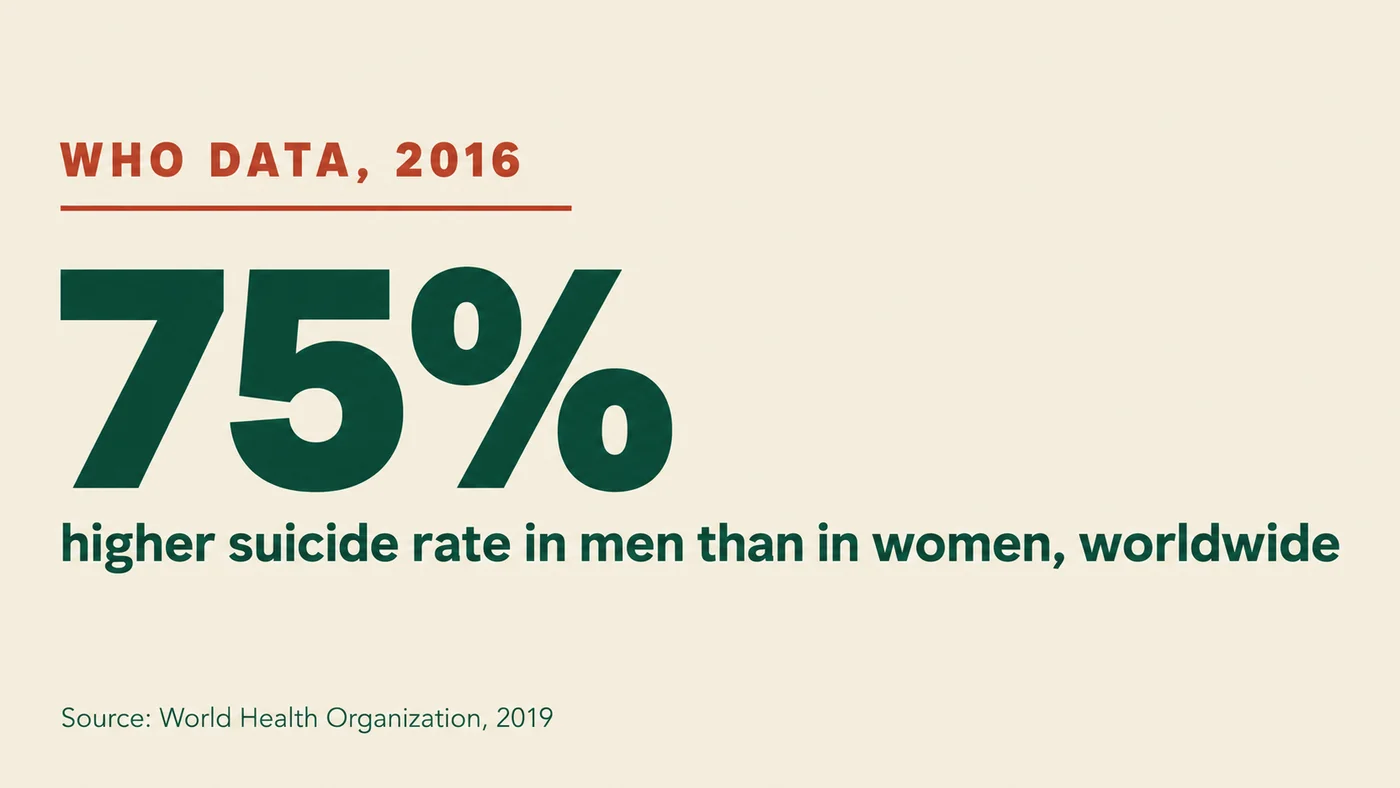
Those figures come from a WHO analysis published in April 2019, using 2016 data, so they describe patterns rather than today’s exact numbers. The patterns, though, are consistent: men are more likely to die early from causes that can often be prevented, and less likely to reach out in time.
The WHO’s suicide fact sheet points to one reason. Stigma, especially around mental health and suicide, means many people who are thinking of ending their lives do not seek the help they need, and breaking down that taboo is an important part of prevention.
Men’s health in Sri Lanka
Reliable, up-to-date figures on men’s health in Sri Lanka are limited, and suicide statistics in particular are hard to measure and often disputed. One of the most carefully analysed sources is a 2015 peer-reviewed paper in the Ceylon Medical Journal by Knipe, Metcalfe and Gunnell. For 2012 it calculated an age-standardised suicide rate of 17.1 per 100,000 people, with a rate of 27.7 per 100,000 for men against 7.7 per 100,000 for women. In other words, men’s rate was more than three times higher.
The same paper carries an encouraging message. Suicide rates had fallen substantially since the mid-1990s, and the authors credit that to Sri Lanka’s firm regulation of access to toxic pesticides. It is a reminder that practical, well-designed action can save lives, and that change is possible here.
Those figures are more than a decade old and should be read as a snapshot, not a current count. What they do show is a clear pattern that matches the global picture: in Sri Lanka, as elsewhere, men are far more likely to die by suicide. Expectations that men should be strong, provide for others and keep their problems to themselves can make it harder to ask for help.
What International Men’s Day looks like in practice
The day does not need a big budget or a formal event. Ways people mark it include:
- Schools running talks or assemblies on respect, friendship and asking for help, and inviting positive male role models to speak.
- Workplaces arranging health checks, short talks on stress, or mentoring. Our guide to marking International Men’s Day at work has eight practical ideas.
- Clinics and health teams offering screening and encouraging men to book the check-up they have been putting off.
- Families making time for fathers, grandfathers, sons and brothers to talk, and saying thank you.
- Communities and charities sharing honest stories from men who have been through difficult times.
How you can take part
- Book a health check you have been putting off, and encourage a friend to do the same. Our article on why men put off talking about their health explains why that first step is hard and how to make it easier.
- Reach out to a man in your life and ask how he is really doing. If you are worried about him, read how to talk to a man who is struggling.
- Thank a father, grandfather, teacher, coach or colleague who has made a difference to you. Our piece on small habits that matter in fatherhood is a good one to share.
- Ask your workplace or school to mark the day, or become a partner of IMD Sri Lanka.
- Follow our updates to hear about venues, speakers and the programme as they are confirmed.
This article is general information, not medical or psychological advice. If you are worried about your health or wellbeing, speak to a doctor or qualified professional.
Frequently asked questions
When is International Men’s Day in 2026?
International Men’s Day is observed every year on 19 November. In 2026 that is a Thursday.
Who founded International Men’s Day?
The official International Men’s Day site credits Dr Jerome Teelucksingh, a history lecturer at the University of the West Indies in Trinidad and Tobago, with founding the day on 19 November 1999.
Is International Men’s Day against International Women’s Day?
No. The organisers say the day is not intended to compete with International Women’s Day. Two of its six pillars are about improving gender relations and promoting gender equality.
What is the 2026 theme for International Men’s Day?
The 2026 theme is “The Future Is Everyone”.
Is International Men’s Day marked in Sri Lanka?
Yes. IMD Sri Lanka is working to bring the conversation to schools, workplaces, clinics and families, and Chris Murray serves as the Sri Lanka Ambassador for the day.
Sources
- International Men’s Day. “History and background.” internationalmensday.com/about/history-background
- International Men’s Day. “The 6 Pillars of International Men’s Day.” internationalmensday.com/about/objectives-of-imd
- International Men’s Day. Official homepage, 2026 theme “The Future is Everyone”. internationalmensday.com
- World Health Organization (4 April 2019). “Uneven access to health services drives life expectancy gaps.” www.who.int/news/item/04-04-2019-uneven-access-to-health-services-drives-life-expectancy-gaps-who
- World Health Organization. “Suicide” fact sheet (updated 28 August 2026). www.who.int/news-room/fact-sheets/detail/suicide
- Knipe DW, Metcalfe C, Gunnell D (2015). “WHO suicide statistics: a cautionary tale.” Ceylon Medical Journal. pmc.ncbi.nlm.nih.gov/articles/PMC4384175
- 1926 National Mental Health Helpline (Find A Helpline listing: 24/7, free, phone and text). findahelpline.com/organizations/1926-national-mental-health-helpline
- CCCline 1333, CCC Foundation (24/7, toll-free, Sinhala, Tamil and English). 1333.lk
- Sri Lanka Sumithrayo, contact details and services. srilankasumithrayo.lk
- Trinidad Guardian (19 November 2023). “Day for men was first celebrated in T&T.” www.guardian.co.tt/article/day-for-men-was-first-celebrated-in-tt-6.2.1856104.70b69376de
Facts checked against these sources on 3 October 2026.
Get updates from IMD Sri Lanka
Venue, programme and speaker news as soon as it is confirmed.